
We started in the South of Bolivia – and quickly had to get to La Paz because of the Covid-19 lockdown. Here you can find our blog entries about our unusual time in Bolivia.

Salar de Uyuni & Eduardo Avaroa Reserva Nacional (13.-17.03.2020)
Uyuni is a dusty and rather boring city in the south of Bolivia. Nevertheless, there are many tourists from all over the world. The reason for this is the proximity to the biggest salt pan on earth – Salar de Uyuni!
The place is well prepared for many tourists. More than 180 different tour operators run different trips in the region with different durations. Unfortunately, they all have different prices and slightly different stops. We therefore spend a whole day searching through the different tour operators and negotiating a suitable offer for us. Actually we wanted to rent bicycles, but with a daily price of 30€ we changed our mind. At the end of the day we exhaustedly find a more or less suitable offer and the next morning we start at 10 o’clock with four Frenchmen and our friendly driver on board towards the train cemetery.
When the salt mining started close to Uyuni, many train lines were needed to transport workers to the city and salt to all of Bolivia. Other minerals were also mined around the city and of course had to be transported away. So an extensive railway network developed, which nowadays has been replaced by road traffic and is therefore closed down. In Uyuni there is therefore a large train cemetery, a collection of rusty locomotives that were used in the past.


We continue our journey to the edge of the Salar de Uyuni, more precisely to Colchani. This place lives of salt mining and of course of tourism. We can follow the steps of salt production. The salt from the salar is on the one hand cut into salt blocks, and on the other hand salt heaps are made from the superficial wet salt. In these heaps the salt is piled up for drying and then transported to Colchani. After further drying, the salt is crushed to the known size and after cleaning, the salt is finally packed and transported to all parts of the country.

Here, we notice the downside of a tour as we experience it: alongside the salt museum, an endless row of souvenir stands have been built up that all offer the same goods. All tours that start from Uyuni stop here and so jeep after jeep after jeep line up. Also the usual announcements of our driver remind strongly of mass tourism. „Here you have 30 minutes, then we have to move on!“ We are accustomed to individual travel and so it is a little strange that we have to follow a schedule or others. But we want to see as much of the region as possible, bicycles are not available in Uyuni because of costs, there are no rental cars and the salar is too wide and dangerous to walk.
After the salt production place we finally go to the salar! We are already very curious, because we have already seen one or the other picture before and hope that we can see some places that are filled with water. But first we have our lunch break at the Dakar monument.

In 2015 the famous Dakar Rally led through the Salar de Uyuni for the first time. According to our driver, however, it was also the last time because the cars‘ GPS devices went crazy. It was very difficult for us to understand because our mobile phone GPS was able to pinpoint our position very precisely, but we had heard the story of GPS devices going crazy several times before.

11.000 sqm large, 140 km long, 110 km wide and a maximum depth of 220 meters are the incredible dimensions of the salt at Salar de Uyuni. Underneath this layer of salt lies the largest lithium deposit on earth. While only Bolivian companies are at work in the salt production, the lithium is firmly in the hands of Chinese companies. This displeases many locals, as they prefer to use the salar for tourism instead of destroying it. As in the Salar de Atacama, the mining of lithium is still in its infancy, but the tendency points more towards increasing exploration by foreign companies. Nevertheless, lithium is a very important substance that is used in batteries or PC systems and is therefore needed worldwide.
We drive a little further after the break and are lucky. We find an area in the salar that is covered with a thin layer of water. At such places the white surface turns into a huge mirror that seems to melt with the sky.

Of course the almost perfect reflection is a lot of fun!


A complete crossing of the salar takes about 3 hours by car. However, we only drive to the middle, to the Isla Incahuasi. The small island is pretty much the only elevation far and wide, lies in the middle of the salar and is covered with huge, hundreds of years old cacti. Before we arrive there, however, we have to stop for a picture-rich stop – due to the dimension of the plain of the salar it is possible to take funny pictures. Of course we do that as well.


Our next stop is Isla Incahuasi!


The day coming towards an end. Before we unfortunately have to leave the salar, we stop once more for the sunset. A short rain shower sets in and provides great reflections of the setting sun!


The return journey is not boring. In the darkness the colony of touring cars must stop. A bus is in the way and has to be driven around. The bus stops because the heavy rain at the edge of the Salar simply washed away the dirt road. No problem for the touring cars to drive around the place, but the bus is not equipped with 4×4 and is also not suitable for off-road use. Two spots have to be bypassed altogether until we are back on a functioning dirt road. We ask our driver if this happens more often: he tells us every week.
In the evening we can toast Lucas’s birthday with beer in the accommodation and even get a cake from the tour people, which we could divide among our group. We spend the night in a hostel that is built of salt blocks.
The next day we start early. First we pass the red, ripe quinoa plants, continue through a small village, to an even smaller village where many lamas run around.


Many of the lamas are decorated with colourful ribbons. This has purely decorative purposes. Once a year there is even a festival in Bolivia, the Flores de Llama. This means flowers of the lama. Then the lamas are dressed up and decorated and a day of celebration is held. Our driver commented the whole thing only with Sexy Llamas!
We continue our journey towards an extensive rock formation, which was created by volcanic eruptions. The Valle de Rocas – the valley of stones – stretches as far as the eye can see and contains interesting stone forms.


We spend our lunch break on a small hill, of course with a view of the volcano. We don’t stay there alone for a long time, as some viscachas join us.


After the break and the use of the Inca toilet (in nature) we continue our trip as usual on over 4.500 masl. and pass many small lagoons, which often have winged inhabitants.


But of course we make it even higher, to almost 5.000 masl.!

Next on the agenda is a famous rock formation! The stone tree – Árbol de Piedra!

Of course there are also several flamingo colonies in the area of the Eduardo Avaroa Reserva Nacional! The most important lagoon in which thousands of flamingos cavort is Laguna Colorada – the colorful lagoon. The name is obvious!

However, the red colour is not always visible. It requires wind to create movement in the lagoon and thus stir up plankton, which is responsible for the characteristic colour. Otherwise the lagoon has only a pale yellow, which is of course also colored. Here, three different species of flamingo cavort, the Flamencos Andinos, the Flamencos Chilenos and the Flamencos Jamesi. The lagoon is the most important breeding ground of flamingos in the region and all of Bolivia. The protection of the animals during this period is especially important, as flamingos can only lay one egg per breeding period.

We continue on, past lamas and vicuñas, to the highest point of our tour. On more than 5.000 masl. we observe a small geyser landscape. In the meantime, energetic exploration is even being started there and geothermal test facilities have been set up at several locations. For us, however, the geyser Sol de Mañana is in focus.


With the last rays of the sun we reach our accommodation. Not only does it have a great view and is surrounded by lamas, but it is also 200 meters away from hot pools! As soon as we have eaten and the sun has set, we run down in the cold and take a hot bath under the Milky Way!


The last day of our tour has begun. Of course the Corona topic has reached us in the meantime. Since two of our group will not return with us to Uyuni, but continue their journey to Chile, the topic on the eve is whether the borders will still be open. On the way to the border we see a landmark which we already could admire from San Pedro de Atacama: the volcano Licancabur!


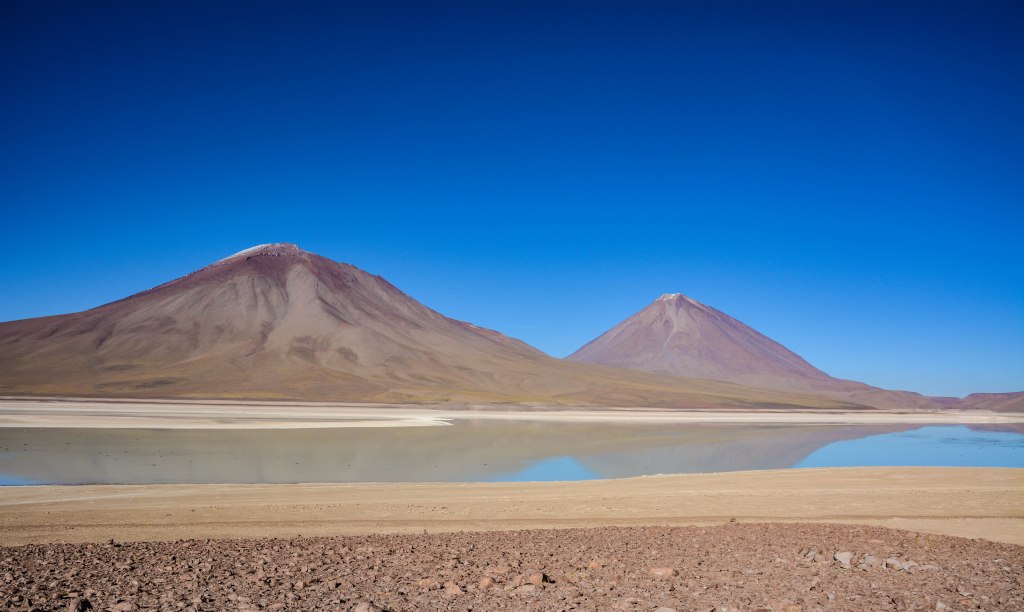
The borders are only open today. After dropping Olivier and Margaux off, we start our way back to Uyuni. Through the Eduardo Avaroa Reserva Nacional we pass volcanoes, snow-capped mountains, vicuñas, lamas, rain clouds and plateaus before we come back to Uyuni in the afternoon.

In Uyuni we notice that the place looks very quiet somehow. When we pick up our backpacks from the tour operator, we are told that there is now a curfew starting at 5 pm. It is 4:50 pm and Diana sprints to the supermarket while Lucas gets two of the last bus tickets to La Paz. The last buses leave Uyuni in the morning of the next day. We also decide to take off, as Uyuni is really not a good place to get stuck. We are happy to catch the last bus the next day and so we stay only one night in Uyuni. In the evening there are already policemen walking through the streets, sending everyone back home or to their accommodation. The next morning we leave the city and drive to La Paz.
Quarantine in La Paz, part 1 (18.03. – 01.05.2020)
The coronavirus finally arrived in Bolivia after a few weeks. As we come back from our tour, we organize two seats in one of the last buses leaving the small village Uyuni and arrive in La Paz in the evening of the following day. Meanwhile, there is also a restriction on movement. This means that from 5 p.m. on, any exit is prohibited and also all shops are closed. In the morning it is still possible to catch buses. But this changes very fast.
Decisions regarding measures against the spread of corona are implemented very promptly. This makes it difficult for us to plan and react quickly and is in principle also responsible for the fact that we are now stuck in a nice hostel in La Paz and are allowed to spend the quarantine period there.
The quarantine proclaimed on 22.03.20 is much stricter than in Germany. Exit is only possible on working days between 8 and 12 o’clock. It is also ensured that few people are on the streets at the same time. This is regulated by the final digit of the ID card (or the last digit in the ID card). On Mondays, people with the last digit of their ID card 1 or 2 are allowed to go shopping, on Tuesdays 3 or 4, and so on. Accordingly, Lucas may go outside on Wednesday and Diana on Thursday. This of course restricts, but we are not the only guests in the hostel. Meanwhile we are four volunteers from Argentina and Uruguay, as well as four guests: Francesco from Italy (who has left in the meantime), Dai from Japan, and both of us.
In the beginning we were 21 people from France, Germany, Canada and Brazil. But the German embassy had already organized a first retrieval action last week, through which the other two Germans left us. One day later, the seven Frenchmen followed in the same way. Yesterday, the Canadian took advantage of the offer of his embassy and started his way home. The Brazilian had left us earlier because she probably didn’t like the hostel.
In the meantime a relaxed atmosphere has spread. In the morning we have breakfast and one of the volunteers from Argentina, Cris, is currently always baking fresh bread. At noon and in the evening we alternate with cooking. It is easier to cook for five people than if each of us would do the shopping and cooking separately. It is also nice to get together at lunch and dinner and joke a little about the state of things – the daily routines are pretty similar every day.


Since we do not want to return to Germany in a hurry, we have decided against taking up the repatriation offer of the Federal Government. Although we are limited by the current measures, we are nevertheless satisfied that they prevent the rapid spread of the virus. At the moment (04.04.2020) there are 11.05 million cases in the whole country, only 139 active cases – this puts Bolivia in fifth last place in South America, only Paraguay and the small territorial states in the north of the continent are less affected.
Another reason for our perseverance is the confirmation for a volunteer work we want to do in the Bolivian jungle. We would be isolated from external influences and could support an organization dedicated to the rehabilitation of wild animals.
Last but not least some impressions from our quarantine time in La Paz! By the way, the city is the highest city on earth, which is between 3.640 and 4.150 HM. Meanwhile we have been here for more than two weeks and got used to the thin air and the occasionally short breath.


The safety regulations in supermarkets are more stringent. When shopping in a large supermarket, you first have to wait in line for entry, because not everyone should be in the market at the same time. If you are the first in line, you must show your ID card. Then the shoes must be wiped off before stepping into a small tub of disinfectant liquid. The penultimate step is to disinfect your hands. Lastly, the temperature is taken. A „thermometer gun“ is held to your head. We don’t go out the door without a mouth guard – you would feel strange on the street without one, because almost everybody wears one.


We are not very happy about the fact that we cannot move at the moment, but such a deceleration is also beneficial. A lot of the stress and strain that had built up over the last few weeks can now finally subside and we can devote ourselves to things that we have been putting off for a long time. Or just watch series. Or we can make sure that we are doing well. Sometimes it’s also quite good to keep your feet still and be confident!
Quarantine in La Paz, part 2 (02.05.2020 – 27.05.2020)
It is now five weeks since the complete and strict quarantine was declared in Bolivia. The number of cases is still in the low range in South American comparison – the restrictions are still very strong.
Since the quarantine began, Lucas is allowed to leave the hostel on Wednesday and Diana on Thursday because of our passport numbers. The precautions in the supermarkets and open-air markets are becoming more and more strict – if at first there was only a mask obligation, this has now been extended to include an obligation to wear gloves. In addition, most supermarkets now have tanks of disinfectant so that all customers are hosed down before entering the market.
As we are accommodated in Sopocachi, a quite wealthy quarter, we like to walk a little further to the biggest market of La Paz, the Mercardo Rodriguez, on the days when we are allowed to leave the hostel: there we find everything our heart desires at very affordable prices. Thus, for example six huge avocados for 10 Bolivianos (approximately 1,30 €) or four kilos of potatoes for 20 Bolivianos (approximately 2,70 €). Despite of the continuous prolongation of the quarantine and the tightening of the restrictions, we have already experienced some strange things.
When Lucas left the hostel on Wednesday to visit our favourite market, he is usually controlled by three military policemen until the fourth says that foreigners are not allowed on the Mercado Rodriguez – which of course frustrates us. The next day Diana still tries again and can go to the market without any problems. The rules are not always very clear. Fortunately, there are also other markets, practically in every district of La Paz there is a small market hall where fresh goods are offered.
When Lucas is allowed to leave the hostel again on a Wednesday, he takes the opportunity to walk towards El Alto. El Alto means translated „the altitude“. Although there is no real border between El Alto and La Paz, El Alto is the highest city in the world – almost 850.000 inhabitants live here on about 4.150 masl.. Thus, El Alto is about 500 masl. above the city centre of La Paz, which lies at 3.600 masl. If you move from the centre towards El Alto, you will hardly avoid using stairs, unless the Teleferico is driving of course (but this is not the case during quarantine).


Moreover, in La Paz there are probably only a handful of straight roads, except in the centre. It always goes up or down. Walking in this city is perfectly adequate for training.

The closer you get to El Alto, the fewer people you meet on the streets, but the more dogs.


Once you arrive at a house-free height, the view over the city and surrounding mountains is spectacular.

La Paz is surrounded by high mountains. In one direction is the Illimani, in the other direction is the Huayna Potosí. This one does not only stand out due to its height from the landscape with 6.088 HM, but also stands quite lonely in the Cordillera Real.


But also in the low located city centre of La Paz one can enjoy some nice mountain views.

In the hostel we spend our time in different ways. Cooking takes up a large part of the time. But there is always very tasty food:


As an evening activity we often play Truco, a complex card game from Argentina, but anyone can learn it. The advantage is that you can play Truco in pairs, but also in fours or sixes. With the two Argentineans in the Hostel Cris and Fausto it is most fun, because they are extremely emotional and at the same time can teach us new skills for the game. When we play Truco, it can also be very late, because for the two Argentines it always means that there has to be a revenge match and then of course there has to be a deciding match.
When it is sunny in the morning, we spend time on the balcony. From this balcony you have a beautiful view of the snow-covered mountains, independent of the time of day.

Even in bad weather you can enjoy the view, provided the sun shines through the clouds:

Necessity is the mother of invention – at the moment all shops are closed except supermarkets. But Lucas‘ hair does not get short by itself. So Diana takes – a little bit reluctantly – the hair clipper and cuts Lucas‘ hair short. Of course, the whole thing should not be in vain. The company 4Ocean, which usually sells products (e.g. recycled bracelets) to fish plastic waste from the oceans, pulls a pound (500g) of plastic waste from the oceans for every picture on Instagram with the signature #cleancutsforcleanoceans.

In the meantime, the line-up in our hostel had changed a little – Francesco from Italy had left us with a retrieval action, but we had two newcomers: Piyum from the States and Arvid from the Netherlands. So we were eight people in the hostel for a short time. But then the two Argentineans left us (with a 60-hour bus ride to Buenos Aires) and Piyum was also able to get a return flight to the States.
Since the two Argentineans left us, we could both fill in as volunteers to save a little rent. So we work from Friday to Sunday so that the hostel looks as nice as never before. At the moment the status is that the quarantine will last until 30.04.2020. We hope that there will not be an extension again the evening before so that we can finally continue our journey – into the jungle to Rurrenabaque.
Quarantine in La Paz, part 3 (28.05.2020 – 01.06.2020)
It is now the second month of strict quarantine and we are still in the same hostel in La Paz. There are only a few of us left: Arvid from Holland, Guilia from Italy, Dai from Japan, Maxi from Uruguay and the rest of us. We still spend our time the same way as before – shopping, cooking, little detours to viewpoints and other things that come up!


But within a few days Arvid and Dai leave us. They both spontaneously got the opportunity to take part in a return flight. Thus, we are suddenly only four people in the hostel. Meanwhile the end of quarantine is not in sight. It is slowly getting a bit lonelier and we are also a little bit sad that the others, whom we have won as friends, are leaving. Of course we are happy for everyone, but a little melancholy also comes along.

The situation in Bolivia varies greatly depending on the department (cf. federal state). In La Paz the number of cases is stable at around 200, but in Beni or Santa Cruz the numbers are rising sharply and are many times higher than in the regions of the Altiplano. Nevertheless, compared to the neighbouring countries Peru, Chile and Argentina, the numbers are low and are far from rising as strongly. A guest in our hostel, who was with us for a few days, tells us about the political dimension of the quarantine: the coup d’état president Evo Morales seems to want to return to power with all means and tries to make the interim president Jeanine Áñez look as badly as possible. Rumours are circulating that he is supposed to pay families with deceased relatives to testify that their relatives died with Covid symptoms or even directly from the disease. Thus, they are counted as cases in the statistics. It is also rumoured that he also pays people with symptoms to infect his fellow citizens at markets and other places. However, these are said to be only a few of the criminal acts committed by the ex-president from his exile in Argentina.
The same guest who told us about the circumstances in the country works at the Ministry of Justice and gives us the opportunity to apply for a travel permit so that we can leave for Rurrenabaque early.
We do not want to leave this untried and so we contact the German Embassy in La Paz. They are very helpful and send us a letter with which we apply for the travel permit. Also the organization ONCA in Rurrenabaque sends us a letter about the urgency of our trip. When we apply for the permit, we are in good spirits and – thanks to the help of the embassy – receive it the very next day.
Of course, we have already organized a driver (one of the hostel owners) to take us to Rurrenabaque with his car. After we have all the necessary documents together, we decide to leave the next day. This is mainly because the permit is only valid for a few days and on weekends there are increased controls – driving is generally prohibited on Saturday and Sunday (except with a permit). But since we want to avoid difficulties and bribery, we leave early the next day in the direction of Rurrenabaque!
Our things are packed and so we start our trip to Rurre at 5 am. With all documents in our luggage we drive through the empty streets of La Paz higher and higher until we reach the city limit. First checkpoint. A small man sits in an even smaller control house and demands our documents. Our driver Fernando hands him the documents and adds: „These are veterinarians, they have to go to the organization ONCA in Rurrenabaque“. The little man turns around and Fernando looks at us and asks „You are veterinarians, aren’t you?“ We deny and he laughs. The documents are handed back and we can continue our journey at dawn.
Soon we reach the highest point of our ride at about 4.500 masl. This is the point where we can slowly see the Amazon basin. The sun is just rising and we can observe a beautiful play of light between the high mountains of the Andes and the low lying Amazon basin. The road quickly leads to lower altitudes and an hour later we are already only at about 1,000 masl. The road is still tarred all the way through, but that will change soon.
In the small places in the depths of the Departamento La Paz we have to pass some Corona checkpoints from time to time. For this we have to get out of the car, wash our hands, then walk through the disinfection tunnel (turning once in a circle) and then our documents are checked intensly. If we get out of the car, we are always looked at a little sceptically, because one can see in spite of mouthguards that we are probably not Bolivians, but as soon as we can show the document from the embassy, it is always very easy and we can pass. So get back into the car and drive on to the next checkpoint.
Meanwhile, the quality of the road continues to deteriorate. The wonderfully tarred road is temporarily transformed into a mogul slope, a muddy road or is covered by landslides. Fortunately, the rainy season is already over, so it is definitely easier to pass the critical spots. Nevertheless, we have to avoid collapsed tunnels and also have to avoid one or the other truck standing crosswise. Fernando is a very good driver, but even he can’t avoid all potholes or bumps, so that the car gets one or the other blow.
After 12 hours of driving we arrive at the seventh checkpoint at a bridge. Before the bridge we get off and go through the usual control procedure and after a few questions we are allowed to continue our journey. At the other end of the bridge we have to get off again and go through the control procedure. As we get out of the car a military policeman comes up to us and asks for our documents. We show him all our documents, but he suddenly demands an additional document: a medical certificate that we have been tested for Corona. However, as we now know, due to the scarcity of testing capacity, this is only possible for people who show symptoms, which we of course do not do. Therefore, he sends us back to La Paz.
But we do not want to accept this. We approach another one of the military police officers present and he is very helpful. He even lends us his telephone so that we can call the German Embassy in La Paz and our contact lady. He also gives us the number of the mayor of Rurrenabaque so that the embassy can contact him as well. The problem is further aggravated by the fact that today is Friday and Rurrenabaque will be encapsulated for the weekend. This means that the city limits will be closed on Friday at 5 pm and neither entry nor exit will be possible. So we are running out of time.
At the checkpoint a doctor is present and we ask her if she could test us for the virus, but she immediately denies. We suspect that she doesn’t want to waste the few test kits on two foreigners because she refuses so vehemently.
A short time later the embassy contacts us and informs us that unfortunately they couldn’t do anything for us because the mayor did not answer the calls. There were difficulties while the embassy tried to bring other German travellers from Rurrenabaque to La Paz for rescue flights, so that the mayor apparently does not want to respond to our request. Thus, we decide to contact the mayor with our mobile phone and actually reach him, as he does not know our number. He tells us that we are welcome to do a test in an institute in the region before we can enter the city on Monday when the encapsulation is over. However, this possibility is not feasible for us, because the military policeman had already told us that the people in Rurrenabaque are not very well disposed towards foreigners at the moment. Some are said to have even said that all people who are infected with the virus should be burned. So the possibility to wait outside the gates of the town is out of the question, because we also can’t afford to pay Fernando for the long time and our travel permit also expires. So our hands are tied, we have to decide with a heavy heart to take the long trip again and return to La Paz…
On the journey we are very silent at first and try to process what has just happened. First of all we are sad that we can’t go to ONCA to the jungle, but also a little bit angry that the organizer didn’t tell us properly what the situation in Rurrenabaque is like at the moment. It is slowly getting dark and we think about the best place to stay overnight. We want to make it as far as possible so that the next day is only a short one, but before we can finish our thoughts Fernando drives through a pothole and one of the rear tyres bursts.
It is pitch black and we are standing in the middle of the jungle. There is no village for 5 km around and we are standing in the middle of the road. But that is no problem, because in the trunk there is a spare wheel. After we have cleared out our backpacks and lift the cover, however, we realize that it should not be so easy after all. The spare wheel is also flat…
We try to make the passing vehicles aware of our unfortunate situation with our flashlights. Normally trucks always have a compressor with them and so we try to make a truck stop. In Bolivia, however, cars are often attacked by faking an accident and so many of the trucks drive past us quickly. Now and then a driver stops, however, unfortunately, we have no luck with the suitable compressor for our small car wheel. After about 30 minutes a private car drives past us and says that on his way back he can take a person to the next village and also bring them back again – of course for a small payment. Later, he actually comes back and takes Fernando with him so that he can take care of the tire repair. Thus, we both stand alone, with the key in the ignition somewhere in the Bolivian jungle and wait – and above all we hope that nobody comes by with crooked thoughts. Of course, the soundscape in the jungle does not exactly contribute to our well-being, but after 30 minutes, which feel much longer, Fernando comes back with the inflated spare wheel and we drive straight to the next village where we have both wheels repaired. As it turned out, the spare wheel was also broken.
It takes until midnight before we can continue our journey. During the repair we can at least marvel at the Milky Way in full expansion and forget for a short moment the unpleasant events of the day. We pass a Corona checkpoint and spend the night in a car at a gas station. Surprisingly, we even sleep very deeply and firmly.
The next day we continue the journey back. We pass all checkpoints without any difficulties and enjoy once again all the muddy and bumpy parts of the Ruta Nacional back to La Paz.


We arrived in La Paz, the amazement of Guilia and Maxi is enormous, when we suddenly stand in the corridor again. We tell them the story, take a shower and fall into bed tired – and sleep until the next day (16 hours!). We resume our work as volunteers in the hostel and things start going their usual way again. But then Guilia also gets the chance to return to Italy and takes it – so we are only three people in the hostel.

Unfortunately, it is not always possible to choose the guests in the hostel: one day a somewhat older guest comes to the hostel, who does not take social-acceptable behaviour too seriously. But we can overlook that. What we cannot overlook, however, is that he does not comply with the quarantine regulations. Above all, he sits coughing in the common room in the evening and we just don’t have a good feeling about the fact that he is outside all day every day and doesn’t comply with the regulations (go outside once a week, based on the final number in his passport). The rules have been relaxed slightly, we are now allowed to go outside until 2 pm and yet the older man does not return until two hours later. We tell him several times to follow the rules, but he either doesn’t listen to us properly or doesn’t take us seriously. But we are getting fed up with it and one day Lucas tells him that as long as he is a guest in the hostel, he doesn’t only makes decisions that affect him, but also the other hostel guests – and that he should obey the quarantine regulations. However, he simply walks away in the middle of the conversation and so we assume that he will find another place to stay.
We thought wrong! The next morning we come into the common room for breakfast and are grumbled at that we don’t have to play police and don’t have to act up. We make it clear to him that we have already been in quarantine for over two months and that we don’t want to get into trouble because of his reckless behaviour during the last few days (as a relaxation is already in sight) – especially since he is a bit older and always coughing in the hostel. The feeling is just not right. Finally we make him realize that if he wants to go out every day, he has to go to another hostel. Again we assume that this is the end of the matter.
We thought wrong! The next day he comes to the reception and wants to pay for more nights. Lucas asks him if he wants to respect the quarantines from now on and he answers decidedly no and gives the following reasons: He doesn’t want to be denied his freedom by Lucas as a German because he’s an Israeli. Lucas is totally perplexed by this statement and makes him pay for more nights. When the shock has subsided and Diana is back from shopping, we contact the hostel owner and point out the reckless behaviour of the guest. He assures us to ask the guest to leave. But the unpleasant part is still to come. When the elderly man returns, we wait in the reception in pairs. We get a downright hate triad, that we are Nazis, want to play police and even anti-Semites. But we don’t get involved in such a discussion anymore and are relieved when he leaves the hostel. You really can’t pick and choose hostel guests. We are not really afraid to get infected with the virus, because we stick to the measures, but we also don’t want to let it happen by the reckless decisions of others. In the previous months, all hostel guests had managed to comply with the rules and treat each other with respect. None of us were happy about this, as the freedom of each individual was massively restricted, but we were aware that tourists in particular have a responsibility not to provoke the spread of the disease in another country where they are hosted.
After we had a quiet day, where we had a small barbecue party with friends of Maxi – who of course all complied with the quarantine regulations – the doorbell rings in the evening. Lucas opens and an older lady enters. This lady is the exact opposite of the older man. She immediately shows us all documents and proof that she has no corona symptoms. Sometimes you are just happy that friendly people come to the hostel who appreciate your efforts.

Another important date in our quarantine period is our third anniversary. Unfortunately we couldn’t get out, but we found the balcony to be the perfect place for breakfast – directly in the sun! To celebrate the day Diana even made pancakes for breakfast.

The current situation in Bolivia is still very complicated. While the departamentos of the Altiplano are much less affected than those in the Amazon region, the restrictions are still severe. Especially in Beni and Santa Cruz, the number of cases is increasing and a medical catastrophe has been declared. The health minister of Beni even had protection equipment for the medical staff bought and then resold it himself – of course profitably for his own good, which was also a nationwide scandal. Of course, this does not make the situation any better. Nevertheless, we notice that the relaxation in La Paz is eagerly desired. The number of cases here is low, between 200 and 300. We are also following the local media to obtain information about how the restrictions are continuing in the country. These have let it be seen that it is being relaxed in the less affected areas.
On May 30th, something promising happens: the gondolas of the Teleferico are completely suspended again for the first time and are put to the test. A good sign! We sit on our balcony for a long time and watch the yellow gondolas and how they are going up and down in front of the beautiful mountain scenery. We are a little bit tense because we have been waiting for two and a half months and then on Sunday evening we are finally released: the quarantine in La Paz will be less strict!

That means: the public transport (Teleferico and busses) is working again, we can go outside every day and the curfew now lasts from 18 – 7 o’clock in the morning. A clear improvement compared to the last weeks and we are very excited to walk together through the streets of La Paz for the first time. Of course only with a mouth guard, because it is still obligatory.

La Paz and El Alto (01.06.2020 – today)
On Monday morning (01.06.20) we wake up to a mechanical whirring outside our hostel. A little confused we open the curtains and we are presented with an unusual sight: the Teleferico is working! Before our eyes the gondolas float along the yellow line and are the sign for us that the quarantine restrictions have been relaxed after more than two months. Unfortunately, we cannot leave the hostel on this day, because the owner of the hostel was not able to follow his announcements and show up at the hostel. Since we don’t want to leave the hostel alone, we spend the first day we are allowed to go outside frustrated on our balcony and watch the Teleferico gondolas going up and down.

La Paz
But the next day we can leave the hostel together for the first time and have a closer look at the city. First we do some organisational things before we dedicate ourselves to walking and experiencing the city. We pass the touristic part of the city, which is completely deserted. Most of the travellers have probably retreated and taken advantage of the return flight offers of the respective embassies. The shopkeepers are a little confused to see us and everyone addresses us personally. After all, we are the only two people in the empty street – with the exception of the shopkeepers, of course. They all are opened for the first time in two months and now they have to make up for the financial loss of the past weeks.


By further roaming through the small alleyways we notice a lot of street-art artworks:


We walk through the Mercado de las Brujas (witch market) – or at least the three stalls that decided to reopen after the quarantine. Here you can buy all kinds of things for ritual sacrifices or alternative remedies. Particularly striking, however, are the mummified lama babies used as offerings.


Then it’s finally happening! After we have a soup and a main course during lunch for unbelievable 10 Bolivianos (approximately 1,40 €), we ride the Teleferico. After we disinfect our hands at the entrance, buy a ticket and queue up well-behaved considering the required safety distance, we get into a gondola of the purple line and soon float over the roofs of the brick houses towards El Alto!


After we could enjoy the view from El Alto to La Paz, we ride back to the hostel with the yellow line.

For us, it is already certain that the Teleferico is the best mean of transport of the world: it is clearly quieter than the car or bus traffic, no underground shafts have to be created (as it is the case of the subway; something that would also not be possible in La Paz due to the rocks), the gondola rate is very high and the view in this case is unique (either to the mountains as also to the roof terraces of many people).
After we were always alone at Mercado Rodríguez in the previous weeks, we can now finally stroll together along the biggest food market of the city. It offers a great view to the slopes of the valley, which are full of brick houses.


Of course we use the cable car system several more times in the following days. We are able to see many corners of the city and take in many different perspectives.


The best view over La Paz can be enjoyed from a view point in El Alto – the panorama extends from Huayna Potosí in the north up to the guard of the city, Illimani.


In order to get from the centre of La Paz to El Alto, it is best to take the purple line. This line is called Corazón a Corazón (heart to heart) and is so called because it goes from city centre to city centre.
El Alto
In former times, El Alto was a district of La Paz, but today, the city at a higher altitude has more inhabitants than its neighbour in the basin. But El Alto is very different from the lower situated administrative centre. It is not located in the valley, but already in the Altiplano plateau and thus approximately 500 meters higher on a legendary 4.150 masl. So far up, it is on average 2 degrees cooler than in La Paz and also much rougher and windier.
We spend a little time in El Alto, because there is the largest feria in South America – a huge open-air flea market that stretches over 5 km through the wide, chessboard streets of the city. Here you can find everything the heart desires: electronics next to clothes, cars and accessories next to butchers and all in all a lot of different and colourful goods. In addition, the market is also quite a hustle and bustle, despite existing distance regulations. El Alto is a very poor city and the previously existing rules could for the most part not be obeyed, as the sellers have to finance their living.


The huge market extends up to the city limit – a natural border that represents the slope to the valley to La Paz. Here, the way down is steep and the view is great.

The Teleferico offers a good view to some of the balconies that are exactly at such steep places. The mere sight of them makes us feel weird.

But our eyes are constantly caught by the great view to La Paz and the surrounding mountains. We simply cannot get enough of it.


One of the cable car lines in El Alto (blue) deals with a Bolivian collective trauma. In the saltpetre war (Guerra del Pacífico) between Bolivia and Chile, which ended in 1883, Bolivia lost its access to the sea. However, the idea that the sea belongs to Bolivia is very strongly anchored in the minds of the people (for example in schools). Thus, the blue line of the Telefericos carries quotations in the gondolas as this one:

The loss of access to the sea is a sting that still sits deeply – but this is also indoctrinated. The Bolivians don’t really like the Chileans and we got to know Chileans who have made very bad experiences in Bolivia. But often this collective enemy is also used to distract from their own internal problems.
Fight against windmills or experiences with the Bolivian authorities
One of these problems lies, for example, in the administrative apparatus. A Bolivian woman in the hostel said that under Morales it was not better, but one knew how the system worked and could adapt to the rules accordingly. Now that the new president is in power, one doesn’t even know how the system works. We notice this too.
We decided to try again to travel to Rurrenabaque. Since there are still no flights, we want to try it again by land – it seems that we have already coped well with the strains of the last trip. From some French people who successfully managed the trip to Rurrenabaque we get important information and numbers of border officials and military personnel who could potentially help us to get there as well. Upon arrival we will be in an ultra-strict quarantine in an empty school for another two weeks.
So we contact the military, which is positioned at the border station of Rurrenabaque. He recommends that Andrés, the organizer of ONCA, contacts him. We follow the advice and start to obtain all necessary documents for the trip. We get the documents from ONCA, the hostel in La Paz and the German Embassy without any problems. More difficult is the document Certificado Médico. This document should prove that we do not show any symptoms of the virus. Not a difficult thing, one would think.
We contact various institutions of the Bolivian health system, which is completely overstrained at the moment. In La Paz, for example, there are 10 intensive care beds for patients with the virus who need artificial respiration. However, the city has (together with El Alto) about 1.5 million inhabitants – the definition of severe undersupply. However, in order to obtain the certificate, the health centres require authorisation from the SEDES, the Ministry of Health. However, these are currently not issued, making it virtually impossible to obtain a certificate. To get information, we visit the SEDES.

As a sign is hung on the building that says that you have to contact a lady on the second floor for certificates, we head purposefully towards her office. There we are firstly pampered by a not very friendly employee that no certificates are issued at the moment. But we want to know more about it and wait until the lady welcomes us. However, she cannot give us any information. Disappointed we return to the hostel. But there one of the owners helps us, because he has a doctor friend who can give us an unofficial certificate – without examination. The next day we hear on TV that some SEDES employees have gone on hunger strike because they are overtaxed by the state.
Finally we have all the documents (we even got a travel permit again) and prepare for the nightly departure. But in the evening Andrés texts us that we shouldn’t leave yet, because the military at the city border of Rurrenabaque says that foreigners are not allowed to enter the city anymore. So we tell our driver Fernando and go to bed frustrated.
The next days do not promise any improvement either. The authorities of the city would like to seal it off hermetically and later announce that the quarantine capacities are exhausted and therefore nobody is allowed to come to Rurrenabaque anymore. Of course this frustrates us even more and we contact the German Embassy again to assess the situation.
Very competent people work in the German Embassy. However, one of the ladies there, who has always supported us very strongly so far, finds very clear words and advises us to leave the country, because the collapse is expected in Bolivia in August – in the health system as well as politically. We are a bit shocked about the clarity of the statement and are considering how to proceed. We have waited so long to finally be able to go into the jungle, but in the meantime we have learned a lot about Bolivia and now we assess the situation differently than a few weeks ago. Nevertheless, after a few difficult hours we decide to put the dream of working with monkeys and ocelot for the time being on ice. We do not see that the situation in dealing with the virus will relax in the next weeks (and months). We also do not see that Rurrenabaque will soon open up to foreigners, let alone that the mentality of the people will change abruptly. So we have not managed to do everything in our power to come to the ONCA. Now we have to organize a return flight to Germany and thus ringing in the end of our journey.
A few days ago the first cases from Rurrenabaque were reported. We don’t want to imagine how the authorities there react and act now and we are also a little bit relieved not to be there at the moment. In La Paz it was also announced to go into a stricter quarantine form again. This means that alternately only people with an even or odd number in their passports are allowed to leave the house. The loosening was taken back accordingly and we are only allowed to leave the hostel every second day. So the search for return flights has started for us.
Huayna Potosí (26. – 28.06.2020)
Every time we use the Teleferico we can enjoy the beautiful mountain silhouettes of Huayna Potosí and Illimani. Both mountains are over 6,000 meters high and their snow-covered peaks exert an irresistible fascination. Since we have decided to return to Germany, Lucas wants to experience something that has something to do with one of these mountains.
I start to contact some of the local mountain guides. The Bolivian Mountaineers answer quickly, but want a disproportionate amount of money and think that the normal route of the Huayna Potosí is not passable at the moment. I already abolish the idea of climbing the beautiful snowy summit. Piyum, the American who had also spent part of the quarantine with us here, however, had told me about a very good guide, and I ask him for his number. When I contact this guide, it also takes a day to get an answer, but it is positive: it is no problem to walk the route, he gives me a good price and asks when I would like to start. For Diana this hike was unfortunately ruled out because she did not want to climb the sloping glacier walls of the mountain.
So, after some more thinking, I meet with Teo the next day for a preliminary meeting at the Plaza San Francisco. Here we discuss the last organizational details. Teo has been working as a mountain guide for 15 years and during this time he has spent more nights on the mountain than in his house in El Alto. So I feel well taken care of and we arrange a meeting point for the next day to set off towards Huayna Potosí.
So the next day I get up early, have breakfast with Diana and leave the hostel with my backpack. While I am floating with the Teleferico towards the meeting point, many thoughts come to my mind: Is it a good idea? What if the route is really not passable? Will I be able to cope with the altitude? I have hardly been able to do any sport for the last 3 months. But all these thoughts are pushed into the back of my head when the gondola floats so high that I can see the summit of Huayna Potosí again. The weather is perfect, not a cloud in the sky and it does not seem to be windy either. Now or never, I think to myself and continue my ride.
At the meeting point I wait only a few seconds until Teo arrives. He already has our food for the coming days. We get into the car and drive off. Next to us in the car are the owner of Campo Alto and Teo’s daughter. We drive directly out of El Alto and stop on the way only once more to buy coca leaves. These are good for coping with the altitude and have a stimulating effect. Many Bolivians put some leaves inside their cheek, but I decide to drink the leaves in tea.
We leave town and drive along a bumpy gravel road towards Campo Basó. After passing the first hill we have an incredible view for Huayna Potosí!

Huayna Potosí is one of 13 peaks in Bolivia that are over 6.000 meters high. It is located in the Cordillera Real, the royal mountain range in the north of La Paz. The drive to Campo Basó close to Paso Zongo takes about an hour and just before we arrive we come to a checkpoint. Teo gets out and walks into the cottage and comes out jogging a little later. In the car he puts a big hat on my head and says: „Look down, foreigners are not allowed to go further here! I do as I am told and we drive on. None of the policemen even look at our car. Just got lucky again. So we continue our journey.
A little later we arrive at Campo Basó. The house is located directly at a reservoir and there is a great view of the mountain to be climbed. Meanwhile we are at 4.750 masl. After a small lunch we relax a little in the sun, pack our equipment later and walk to the Glaciar Viejo. It is a short hike and the weather is perfect! It is warm, there is no wind and clouds are not in sight.
Arriving at the glacier, we strap on our crampons, put on our helmets and climbing harnesses and take the ice axe in our hands. Then we start and walk across the glacier. Teo teaches me different techniques on how to best overcome the different gradients in the ice, how to position the rope, how to use the ice axe and most importantly, how to put down the equipment without losing it immediately. Then we come to the edge of the glacier and I can practice actual climbing in the ice wall.


We spend some more time at the glacier. Normally the groups are up to 3 persons, but due to the quarantine development there are almost no tourists left. So I am alone with Teo and accordingly he is perfectly responsive to my pace and we are very flexible with breaks and the like.

Then we walk back along the glacier lake.


Back at Campo Basó we enjoy the great view!

But we are not alone in this. Around the Campo Basó some dogs run around. These work like an alarm system, as soon as a car or a person approaches, all dogs run there together and bark like hell.

In the evening two more hikers arrive. A young mountain guide with his client, both from La Paz and El Alto. In the evening, we talk a little during dinner and the two guides are sad because of the bad tourist situation. There is an uncertainty, but both are optimistic that it will soon be better again.
After an early night, I get up at 6am the next morning, put on my warm clothes and walk behind Campo Basó to a small peak to watch the sunrise on the snow covered slopes of Huayna Potosí. Not a bad decision.


Huayna Potosí is a word from Aymara language and means young mountain. In the department of Potosí there is a mountain that looks very similar to this one, but geologically it is much older. Teo also speaks Aymara with the people who live in Campo Basó and for me it sounds a little bit like a Turk language. In any case, there are no similarities with Spanish.
After sunrise I walk back down to Campo Basó. There we have breakfast and prepare our backpacks for the short day’s hike. Today Teo is looking at my running rhythm to know when we have to start the next day in order to reach the summit early.

We walk along the dam again, but this time we turn in the opposite direction. This time we can see Glaciar Viejo from further up. The daily stage is short and we relax a little in the sun. After 2 hours we arrive at Campo Alto.

Campo Alto on 5,200 masl is not a real hut, but more a wooden and metal house with a thin roof. But the view is unique and we are very close to Glaciar Zongo.


We spent the rest of the day sunbathing, eating, drinking coca tea, talking nonsense and preparing the backpack again.


After dinner we had a short preparatory talk and after everything was settled, we went to bed – but not without enjoying the sunset.


At 6 o’clock in the evening I go to bed – but in the hut it gets cold at night, so I took a bottle of cooking water with me in the sleeping bag. As it is still very early, I have difficulties to fall asleep and when the alarm clock rings at 00:30 o’clock, I could at least get some sleep. The night in the hut was very loud, because it was very windy, but when the alarm clock rings it is quiet outside. The wind has stopped. The night is starry – perfect hiking and climbing conditions. After a few coca teas we are ready to go.

After a few minutes we arrive at Glaciar Zongo. We strap on our crampons, take out the rest of our equipment and start climbing. In the light of our headlamps we continue our ascent over the glacier. In the distance we can see the lights of El Alto.
After a little while we get to the most technical part. Normally one can enter the escarpment over an ice bridge, but said bridge has collapsed and we need about 1.5 hours to climb over the crevasse at the foot of the cliff. Teo shows all his experience and skills and a little later than expected we climb up the glacier wall.
It’s still pitch-black and we’re getting higher and higher. We take many breaks to gasp for air. I slowly notice the altitude and also that we couldn’t really leave the hostel the last months to do sports. We get closer and closer to the summit and it gets brighter and brighter until finally the sun rises – and warms us up!

We climb up the last meters of altitude and reach the summit at about 8 o’clock! The view is fantastic!


We spend about 20 minutes completely alone on the summit. We haven’t seen the other two since the steep spot. Then we climb back towards Campo Alto. After an essential meal break in the plain below the summit to get some energy back, we continue our hike back to the steep face. After Teo again uses many belay techniques to make sure we can get down without any problems, we can see what it was too dark for in the night.


On the way back we take a picture with my mouthguard – in Bolivia you have to wear it in public life.

On the last glacier section we can enjoy some wide views to the south.


A short time later we arrive at the end of the glacier, pack our equipment into our backpacks and walk the last meters back to Campo Alto. There we also meet the other two again. They had seen how we had tried around on the steep part and decided to turn around.
After a short break at Campo Alto we pack up all our things again and walk back to Campo Basó.

After a soup we set off from Campo Basó. We are facing the same military control that we had already passed on the way here again. But this time Teo doesn’t want to take any risks, he too has already made experiences with the police. So he lets me get out half a kilometre before the checkpoint so that I can pass underneath the checkpoint. Below the checkpoint lies Alto Miluni. That is an abandoned mining town. The place was abandoned after there was a big explosion in the mines in which almost all miners were killed. Today only a cemetery along the road and a few old dilapidated buildings remind of the former place.
It is exactly these buildings that I use as protection not to be seen by the policemen at the checkpoint. This works very well and one kilometre after the checkpoint I walk over a hill back to the road where Teo and his daughter are already waiting for me in the car again. So it worked out well and we drive back to El Alto.
After we arrive in the city, however, I have another 8km march ahead of me – it is Sunday and driving is forbidden as a quarantine measure without a driving permit. So is walking, but I pass only two policemen who don’t care about my presence.
Arriving at the hostel I am happy to see Diana again and after the efforts of the last days we go to bed early.
Last days in La Paz and the return (29.06. – 10.07.2020)
The quarantine form in Bolivia has been stricter again – now only people with even or odd numbers (last no. in the passport document) are allowed to leave the house to go shopping. Fortunately, we have two identity documents, both of which are accepted. However, Diana has two odd final digits and only Lucas can leave the house (almost) every day.
After we had made the decision to go back, we got in touch with the German embassy again and were referred to a travel agency in the Zona Sur of La Paz. The lady based there worked for Lufthansa for a long time and speaks perfect German. Nevertheless, it is also difficult for her to organize a suitable return flight for us. But after a few days she contacted us with the message that she was able to organize a return flight with only one transit for only 1.100€. She calls us again as soon as the tickets are issued. So we are a little calmed down and ready for our last days in La Paz.
It’s Thursday and we want to see the Feria in El Alto again, but this time a different part that is not as crowded. There we find many friendly salesmen who are still surprised to see foreigners.


After we had already took the red Teleferico line over the colourful roofs of the Challuma quarter, we want to walk through the quarter. Therefore, we walk straight over the angular city border between El Alto and La Paz and pass one or two stairs in order to get down the steep slopes.

In Challuma, all houses are painted colorfully and even some big street art projects were made. It doesn’t matter from which side one enters the quarter, one is inevitably greeted by works of art.

It is a warm day – although it is winter/dry season at the moment – but when we enter the quarter, the temperature is much more pleasant and the air quality feels better. The mood is immediately great and we enjoy the relaxed atmosphere between all the colourful houses.


After we are back in the hostel we get a call from Mrs. Reyes from the travel agency – she is annoyed about the state Bolivian airline and has to inform us that the flight has been cancelled. We are frustrated, because we didn’t think that the return flight would be such a burden as well. She assures us to book the next available flight as soon as possible. We know that she is doing everything to help us make the return trip, but we feel helpless and restless as we can’t contribute. We are also tired of waiting, as we have done practically nothing else for the last four months except for waiting for the situation to improve, for the authorities to come to their senses or for the overall situation to change.
In the meantime, we decide to ask the local airlines what the situation is like regarding return flights to Europe. That looks something like this – two scenarios:
(1) The European Way: Go to BOA (Bolivian de Aviacion) or Amaszonas and ask for flights. They say that there are none and you accept the answer, have a nice day and go. No result.
(2) The Bolivian Way: Go to BOA or Amaszonas and ask for flights. They say there are none and now is the point where you have to be unfriendly and force the staff to answer. Statements like, „I know there are flights“ usually help and after a little penetrating questions, the employees suddenly come up with answers. Result.
Nevertheless, these flight options do not help us, as most of the times, there are only flights offered from the big airport of Santa Cruz that is located at a relaxed 18 hours bus drive from La Paz. In itself no problem, except that there are no buses to Santa Cruz at the moment, as this department is the domestic hotspot for corona infections. Therefore, this option is out of question.
A few days later, however, Mrs. Reyes contacts us with the relieving news – she has found a confirmed return flight for us! For a price of 1.200€ per person and with just four transits, this is the best option we have at this time. The next day Lucas takes the Teleferico to Zona Sur to Mrs. Reyes‘ travel agency to process the payment. It is a big advantage that we can leave the hostel on different days, because at the entrance of the Teleferico there are passport checks. So we have received our flight tickets: from La Paz we leave at 06:30 am as planned via Santa Cruz (Bolivia), São Paulo (Brazil) and Zurich (Switzerland) to Frankfurt. 39 hours of travel – we got a better connection than other travel returnees, but with the price also a worse option than others who had already returned earlier with the official repatriation flights. But that didn’t matter at that moment, because we were just happy that we got this connection.
We still use the last days in La Paz to spend some time with Maxi, with whom we had spent the whole time in the Greenhouse.

A few days before departure, Mrs. Reyes sends us an e-mail whose content is typically Bolivian – full of confusing and contradictory information. The mail, which comes from BOA, contains the boarding conditions for the flights from La Paz to São Paulo. It states that we need a Certificado Medico. But as we already found out, these are not issued at the moment. We contact Mrs. Reyes and a lady from Lufthansa in La Paz. Neither of them can give us a definite answer, as this information is new. Mrs. Reyes contacts BOA and later tells us that a test is probably not necessary. However, we do not trust BOA’s statement and based on our previous experiences in Bolivia we ask the lady from Lufthansa for some official laboratories to be able to do a quick test. This is easy, communication in Bolivia often works fast via WhatsApp. So the next evening a doctor comes by and does the quick test with both of us, which of course turns out negative after a short time.

Said mail also says that we have to be at the airport in El Alto at least three hours before departure. This seems exaggerated to us, but we don’t want to endanger our return flight and order a taxi – for 2:50 am on the day of departure.

Lucas uses our last day to get a permanent memory of our trip. He made an appointment in a fancy tattoo studio and got his own designed motive, which Francesco had drawn for him during the quarantine.

On the last evening we catch up with one last round of Truco, the last one against Maxi and his buddy Pierre we had just won with 29 to 30. But this time we let them win so that we can part with a draw (and also so that Maxi lets us go at all).

The alarm clock rings too early and we drag our backpacks into the taxi. After 115 days in La Paz we leave the Greenhouse and head for the airport. It is still dark, only the lights of the city flicker. A nice last sight before we arrive at the dark airport. We are three hours early on time, but there is no trace of the employees of the airline BOA – typical! They arrive relaxed two hours before and in a chaotic manner they organize the check-in. When we arrive at the check-in, we are asked for tickets, identity cards and a medical document. We bring out the results of the quick test and are happy that we did it. But the woman at the counter is sceptical and it takes a short argumentation phase until she accepts the document and checks-in our luggage to Frankfurt. We are relieved. Everything worked out and we can now actually start our journey.
Of course, the plane takes off late – the reason is that too few employees are working at the migration desk and therefore it takes longer. But we know that we don’t miss our connections in any case and are therefore still relaxed. On the plane we meet Mario, who also travels to Germany and works in La Paz. We exchange a lot of information about Bolivia and find out that he too has made many of the experiences we have made. In addition, he tells us a lot about his life in Bolivia and we are partly shocked, on the other hand we can understand all the funny/sad stories he tells us and are therefore not surprised anymore – in Bolivia a lot is possible.

After we take off in La Paz, we fly in the sunrise light very close to Illimani. A perfect picture to say goodbye to La Paz.

In São Paulo we have to go through a security check again, of course. But since BOA could only issue us boarding passes up to São Paulo, nobody has a boarding pass to continue flying. Therefore, the airport staff (who are very unfriendly) doesn’t want to let us pass and asks us to wait at the side. After a few minutes later about 100 people are standing at the side, the staff realizes that they probably can’t maintain their instruction that you can only pass with a boarding pass. However, one of the employees then takes the initiative and takes out a clipboard and writes down the data of each passenger by hand. That takes time, but we have plenty of time to change.

We also have to wait a long time in Zurich – 7.5 hours waiting time to sit in the plane for another 45 minutes. The train would have been faster and more environmentally friendly, but unfortunately we didn’t have that option. Later, we arrive in Frankfurt, and a surprise is waiting for us!

We eat together at the airport before we go to our quarantine apartment in Cologne. Lucas’s sister has given us her apartment and we are happy to have a quiet flat for us after the long journey, where we don’t have to work as volunteers. Since we are both hungry, but too lazy to cook, we treat ourselves to a real German dish.

We made it back! It still feels a little strange to be back, especially because we can’t see our family immediately. Therefore, we decide to do the free Corona test on Monday to shorten the quarantine period.
 Just Geography Things